By Lena Matuszczak
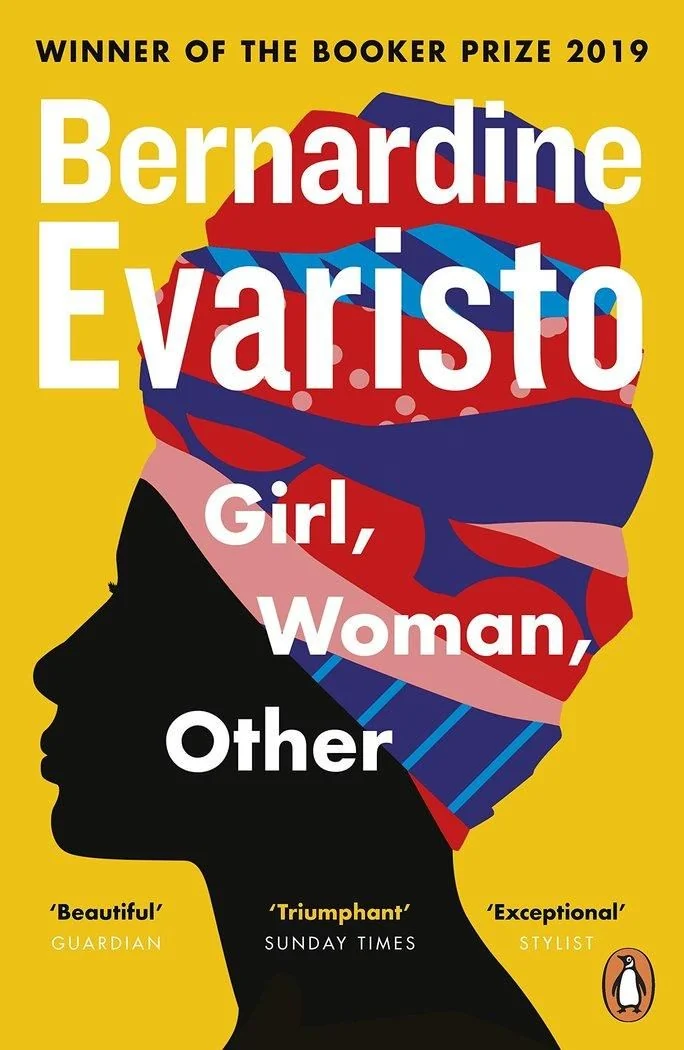
Writing about who has been silenced is one of the defining features of Bernadine Evaristo’s Girl, Woman, Other (2019) which co-won the Booker Prize in 2019. Girl, Woman, Other is a novel that follows twelve characters, the majority of whom are Black British women, across different times, narrated through a creative form of writing the author herself calls “fusion fiction” (BBC 29:13-29:16). The novel explores topics such as feminism, the afterlives of colonialism in British society, and (shared) trauma. The narrative begins on the day of a play’s premiere, moves through the individual stories of the characters and concludes with the afterparty of the play’s premiere, which almost all characters attend. Amma, the first character introduced in the novel, states that “there would be a voice in theatre where there was silence” (Evaristo 14) once her play had been staged. It signals the absence of Black women in British society through the example of theatre, which functions as the foundation for the entire novel. The choice to write about characters whose voices have been silenced and other formal features which structure the novel create a ghostly feeling of something absent, like the afterlives of colonialism and racial violence. Hence, what appears to be absent is indirectly present. This essay explores elements such as the polyphony of voices, writing from a usually not narrated perspective and formal features such as the use of lines in brackets to argue that they produce a sense of spectrality that reflects the unresolved afterlives of colonial violence within the novel.
Hauntology is a theoretical framework based on Jacques Derrida’s Spectres of Marx to examine spectralising elements which complicate ontology (63). In her book Ghostly Matters, Avery Gordon claims “haunting [is] a constituent element of modern social life” (7), and therefore a part of everyday experiences. She adds that writing ghost stories means writing about “exclusions and invisibilities” which need to be seen in a dialogue between “what can be seen and what is in the shadows” (Gordon 17). In Girl, Woman, Other, the everyday narratives of marginalized characters can therefore be read as ghost stories, as the novel’s fragmented perspectives foreground histories of exclusion, invisibility, and erasure. Additionally, she suggests that haunting becomes perceptible through the accumulation of overlapping and incomplete narratives which together create the conditions under which disappearance can be sensed rather than fully represented (Gordon 70). Accordingly, absences may take various forms and carry multiple meanings, while remaining only indirectly perceptible. Within a hauntological framework, the characters’ voices can be understood as spectral not because they lack substance, but because their historical marginalization renders them structurally precarious. They are present yet persistently threatened by erasure. Writing against absence therefore does not aim to correct history by filling gaps, but to register how social life is structured by what has been barely visible or erased. Hence, hauntology interrogates modes of existence by foregrounding absences, as supported by Katy Shaw who states that “the experience of being haunted is one of noticing absences in the present, recognizing fissures, gaps and points of crossover” (2). Consequently, a hauntological reading of the novel’s stylistic choices requires attention not only to what is represented, but also to what remains absent, obscured, or only indirectly perceptible.
The novel is narrated by an extradiegetic heterodiegetic narrator with variable internal focalization, presenting each character’s life separately, while consistently situating them in relation to one another through biological or social connections. The narrative perspective shifts with each character and the temporal focus changes frequently, preventing a linear or unified narrative progression. Structurally, the characters are more or less directly connected through a play written by Amma and their mostly shared setting in contemporary London. Lastly, the novel ends with an epilogue in which the only white character discovers that her biological mother is Black, a revelation that fundamentally alters her understanding of identity and belonging.
One of the most striking, but not entirely stylistic, features is Evaristo’s choice of writing out of and against a usually not narrated perspective. In an interview, Evaristo states: “for me the whole point of the book was to cramp as many Black British women into a novel as I could because I was writing out of an absence because we are just simply not very present in British literature or international literature” (BBC 07:20-08:10). From a hauntological perspective, Evaristo positions both herself and her characters within a literary history marked by exclusion and invisibility. The novel therefore engages with figures who are physically present within society yet historically marginalized and culturally underrepresented, rendering them spectral within dominant literary and social narratives.
Through its polyphony of voices, she is able to include a variety of perspectives from different regions, times, and also different genders. Representative examples include Amma, a Black lesbian playwright, Carole, a successful Black banker, Megan/Morgan, a non-binary social media influencer, and Grace, an Ethiopian woman born in 1895/96 who is reduced by her white husband to “his expedition into Africa” (Evaristo 393). Rather than organizing the novel around a single protagonist or a unifying narrative consciousness, Evaristo constructs a narrative space in which multiple voices coexist, overlap, and remain in productive tension with one another. This polyvocal structure resists narrative hierarchy and instead foregrounds relationality, partial presence, and simultaneity. Characters therefore act spectral in one another’s narratives, appearing indirectly through memory, influence, or ideological tension. As an example, in Amma’s narrative, Yazz, Amma’s daughter whose opinions often oppose her mother’s 1980’s Black British feminist views, claims her future to be non-binary without the need of her mother’s “women’s politics” (Evaristo 39). Hence, Yazz and Amma remain inseparable, as each perspective is shaped through tension with the other.
However, beyond its intersectional representational function, polyphony in Girl, Woman, Other operates as a ghostly narrative mode: voices emerge without dominance, persist without resolution, and are shaped as much by what they omit as by what they articulate. From a hauntological perspective, this relational structure ensures that no narrative is ever fully self-contained. Hence, each voice carries traces of others, echoing experiences that remain partially offstage yet persistently present. An example for this can be found in Amma’s chapter when Yazz is introduced before the reader reaches her chapter. Amma explains their relationship and what Yazz is like from her perspective (Evaristo 37). Through Amma’s perspective, the reader forms an initial impression of Yazz, demonstrating that characters are never presented in isolation but are mediated through the voices of others. These reappearances disturb any clear boundary between centre and margin. It emphasizes the feeling of “navigating the oceans of history and memory” (Sanchez-Palencia 319).
Beyond creating a polyphonic narrative structure, Girl, Woman, Other also establishes what Afza Sabir terms a form of narrative democracy, in which no voice is excluded from the overall picture (296). Hauntologically, this democratic distribution of narrative attention mirrors the logic of haunting itself: voices that have historically been marginalized or silenced are allowed to remain audible alongside others without being subsumed into a totalizing account. Importantly, the polyphony of the novel does not merely multiply voices. It also exposes the uneven conditions under which voices become audible. As Nicole Haring notes, Girl, Woman, Other functions as a Black feminist intervention by foregrounding voices that are frequently excluded from dominant cultural discourse (98). Writing against absence in Girl, Woman, Other is therefore not a supplementary concern but a governing formal principle: absence determines not only who is represented, but also how narration, language, and structure operate throughout the text.
One of the most notable formal features of Evaristo’s novel is a collapse of prose and poetry, the aforementioned “fusion fiction” style. For example, as she rejects conventional punctuation and syntactic expectations, the effect of a “stream of consciousness novel” (BBC 29:28-29:30) is created. One striking feature is the use of brackets. The bracketed lines frequently contain reflections, contextual details or emotional undercurrents that are not fully integrated into the main narrative flow. Visually and syntactically set apart, these passages occupy a position of partial presence: they are included in the text yet marked as supplementary. The brackets function as a grammar of absence. As Gordon argues, the ghost is not simply a missing figure but a social presence through which what is “barely visible” makes itself known, producing haunting as a specific mode of knowing rather than mere representation (8). In Girl, Woman, Other, these elements do not foremost function as stylistic embellishments, but as formal sites where suppressed experiences become perceptible without being fully absorbed into the narrative foreground, as can be seen in the following example:
Perhaps it will stop vile men raping drunken little girls
(and getting away with it)
Perhaps it will stop little girls feeling it’s their fault
(and never tell a soul) (Evaristo 145)
The bracketed lines echo past experiences the character Carole had, left unspoken and haunting her until the moment of speaking. The bracketed lines interrupt the surrounding poetic flow, visually enacting the fragmentation of traumatic memory. Although syntactically secondary, they contain the emotional and historical weight of the passage, exposing how experiences of sexual violence remain structurally marginalized even when articulated. Circling back to Gordon’s argument, the committed crime remains “barely visible” in society, forcing Carole to deal with her trauma in silence. The brackets therefore formalize haunting itself: what is visually peripheral becomes emotionally central, allowing suppressed experiences to persist within the text without ever being fully integrated into narrative resolution.
By conducting a hauntological reading of the novel, the effects of social erasure and silencing in Black British literature emerge as a central concern alongside the novel’s hauntologically rich content. Through its emphasis on incomplete transmission, fragmented narration, and absence, Girl, Woman, Other functions as a reminder of what remains structurally marginalized within both society and literature. The novel uses these missing elements and narrative fragments to challenge conventional modes of storytelling by foregrounding what is usually obscured within dominant social discourse. These absences function as hauntological markers, revealing how stylistic choices formally haunt the narrative itself. The spectral traces of Black British women emerge through Evaristo’s unconventional formal features, which render historically marginalized experiences perceptible without fully resolving their absences. Girl, Woman, Other therefore stands as a particularly productive text for exploring how literary form can register haunting, erasure, and unresolved historical presence in contemporary Black British writing.
Works Cited
“Bernardine Evaristo: Girl, Woman, Other.” World Book Club from BBC, 4 July 2020. www.bbc.com/audio/play/w3cszmx0. Accessed 11 November 2025.
Derrida, Jacques. Specters of Marx. 1993. Routledge, 2006.
Evaristo, Bernadine. Girl, Woman, Other. Penguin, 2019.
Gordon, Avery. Ghostly Matters. 2nd ed., University of Minnesota Press, 2008.
Haring, Nicole. “Vulnerability in Resistance: Intersectional Narratives in Bernadine Evaristo’s Girl, Woman, Other.” Off Campus: Seggau School of Thought, vol. 8, 2022, unipub.uni-graz.at/offcampus/periodical/titleinfo/8486265.
Sabir, Afza. “Feminism and Intersectionality in Contemporary Novels: A Critical Analysis Of “Girl, Woman, Other” By Bernardine Evaristo.” Liberal Journal of Language & Literature Review, vol. 3, no. 2, 2025, llrjournal.com/index.php/11/article/view/146.
Sánchez-Palencia, Carolina. “Feminist/queer/diasporic temporality in Bernardine Evaristo’s Girl, Woman, Other.” European Journal of Women’s Studies, vol. 29, no. 2, 2021, pp. 316-330. https://doi.org/10.1177/13505068211048466.
Shaw, Katy. Hauntology: The Presence of the Past in Twenty-First Century English Literature. Palgrave Macmillan, 2018. https://doi.org/10.1007/978-3-319-74968-6.
About the Author:
Lena Matuszczak (she/her) holds a Bachelor’s degree in English and History from the University of Münster and will pursue a M.A. in British, American, and Postcolonial Studies at the same institution. For her bachelor’s thesis, entitled “Haunted by Herstories: A Feminist Hauntological Reading of Bernadine Evaristo’s Girl, Woman, Other,” she analysed the novel through a hauntological lens, focusing on Black feminist history, intergenerational hauntings, and the female body as an archive. She currently works as a student assistant at the COFUND Postdoctoral Fellowship Programme “Migration, Diaspora, Citizenship” (MDC) at the University of Münster. Her research interests include hauntology, postcolonial literature and theory, and feminist and queer theory.