By Mrunmayee Sathye
While migration has always been at the very heart of human civilisation, the last century has seen a noticeable shift in the way we understand its realities and imagine the very shape of our world. In recent decades, the phenomenon of postcolonial migration has offered itself up to productive theorisations, to a restructuring of dyadic understandings of colonial centre and colonised periphery, in symbolic as well as physical terms. The migrant experience, or rather, the diasporic experience, has often been perceived as emerging from a single movement in time and space—a single crossing—sealed by the moment of arrival. Regardless of whether this mo(ve)ment is taken to signify the end of the journey or its beginning, it seems particularly fruitful to resist such unilateral perceptions of migration in terms of stable lines of demarcation between nations, continents, and cultures.
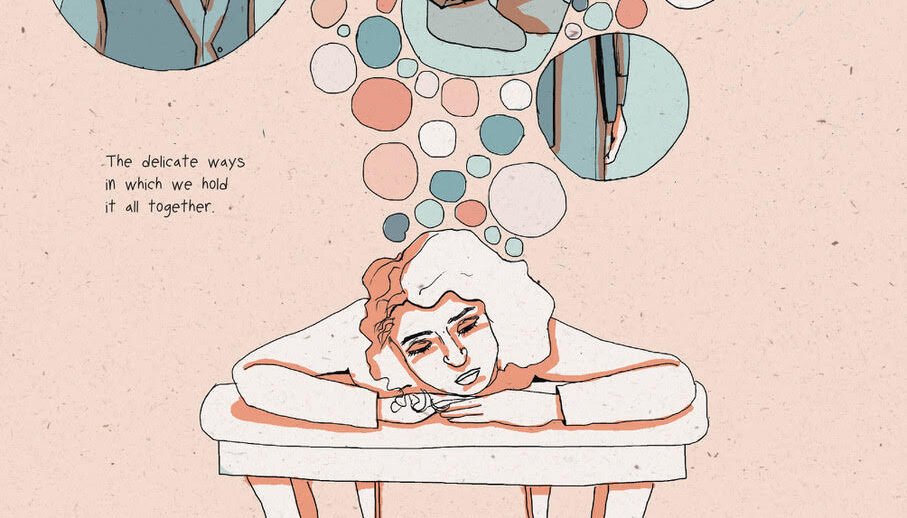
By reimagining the relationship between margin and centre, between inner and outer circles—across a variety of scales and dimensions from the global to the local—, there is much to be gained by engaging with diasporic subjectivity as constituted through multiple crossings across multiple boundaries. A fascinating example of the constructive potentials of such a rethinking can be found in Sabba Khan’s 2021 graphic memoir The Roles We Play, whose depictions of life as a second-generation British Pakistani destabilise and open up dichotomous perceptions of inside and outside, belonging and non-belonging.
In the twenty-first century, the figure of the migrant troubles normative notions of belonging and identity by virtue of its location “‘outside’ of the time-space of the nation”, while diaspora becomes “an emblem of multi-locality, ‘post-nationality’ and non-linearity of both movement and time” (Ahmed et al. 7). In its connotations as ‘dispersion from’, diaspora “embodies a notion of a centre, a locus, a ‘home’ from which the dispersion occurs” (Brah 178). Crucially, in multicultural societies, various genealogies of dispersion come to be entangled with those of ‘staying put’ (Brah 205), bringing together the alien and the native, migrant and local populations; all inhabiting, interacting with, and transforming the same space. This mo(ve)ment, then, does not remain bound to a single journey from origin to destination, but ultimately “invokes images of multiple journeys” (178).
Khan’s story is set in London, a city whose diverse diasporic population turns it into a repository of the untold stories of people who are ‘from there’ but not ‘of there’. As the youngest child of immigrants from Pakistan-controlled Kashmir, Khan’s recollections of her childhood in East London are intimately entangled in the tapestry of her extended family as they built a life together in a foreign land. The narrative encompasses her experiences as a child of the second generation: from second-hand experiences of migration and displacement to first-hand experiences of foreignness, diasporic confusion, racism, and Islamophobia. This lived experience of the liminal dynamics of margin and centre is interwoven with Sabba’s constant grappling with questions of femininity and selfhood within patriarchal, Muslim, and working-class structures in the UK, and a personal journey of growing up. The narrative subject in The Roles We Play is effectively located at the intersection of a multiplicity of (non-dominant) socio-cultural identities—all “the onion layers of othering” (Oliver n.a.) brought to life through vignettes of multiple belongings and non-belongings.
Following bell hooks, “To be in the margin is to be part of the whole but outside the main body” (xvii). Being able to enter the world at the centre but not live there, always having to return to the margin, she locates the salience of the Black American experience—which in the context of this article can be extended to diasporic existence at large—in the specific ability to look “both from the outside in and from the inside out” (xvii), simultaneously aware of both the margin and the centre, inhabiting the threshold between them through constant traversals and transgressions. In terms of the movement through space suggested by the diasporic experience, but also by virtue of the author’s background as an architect, The Roles We Play reads as an illustrated metaphor of space across intimate spheres, familiar places, and geopolitical mappings—depicting the complexities of inhabiting and traversing space through larger and smaller movements across rooms, houses, buildings, streets, cities, countries, and continents.
In many ways, the centring of Khan’s narrative on questions of belonging, identity, and memory, is manifest in her desire to define what home is as much as where home is, and both framings emerge within the story in decidedly spatial terms. In a panel early on in the book, we are confronted with a single door attached to two frames, one on either side—opening on its left onto the image of a woman cooking in a modern kitchen, presumably in their East London house, and leading on its right to a rural idyll with the woman cooking out in the open on a clay stove. The text to the side of the panel reads: “Sometimes it felt like we were in two places at once” (Khan 18). This duality and simultaneity of the two worlds of origin and destination forms a central diasporic truth, and the text incorporates several dualities of worlds: lost homeland and country of arrival, past and present, home and outside world.
Stepping outside the familiar bubble of Green Street to go to university, London seems bigger, more foreign; the capital of the coloniser nation seeming to implicitly tell her that she doesn’t belong, that she may be “from here but not of here” (183). The narrative weaves in and out of the two planes of private and public spaces, portraying a dichotomy of the home and the outside world, whose frontiers Khan is shown as constantly interacting with and repeatedly crossing, both metaphorically and physically within and across panels. This home/outside world duality proves crucial to understanding the two lives of our narrator, each crossing of the threshold influencing the way she dresses, behaves, and feels, her very person split into two distinct beings. Neither of these two worlds, and none of these places, however, seem to feel truly her own: “I can see all the places I’ve called home in this City, like a dream street, a corner, mine but not mine, a borrowed time” (185). Indeed, ‘the City’ plays a central role in Sabba’s journey, a series of splash pages vividly intertwining the protagonist’s life with its vast geographies. In one instance, a large image of Sabba is juxtaposed with the borders of London’s boroughs (183), her very being divided into pieces by the lines on the map. In another, the landmarks of London are transformed into a collage of the places Sabba navigates, illustrated to spread across and merge with the scarf that she draws onto her shoulder (184). Yet another page shows mundane snippets of her life stretching out into the meanders of the Thames, drawn to resemble a London Underground train as she goes about her day in the city (185).
Reading Khan’s narrative through the lens of a metaphor in space leads us to contemplate a series of questions: What happens to the relationship between the margin and the centre if we visualise the boundaries between them not as fixed or stable, but as dynamic and constantly shifting—as lines that refuse to hold? What can be gained by reimagining the visual metaphors we use to conceive of social realities, spaces, and boundaries at large, if we take a step back from the image of a circle with a well-defined centre and a discernible margin? In thinking about diasporic subjectivity, what can be gained by exploring more dynamic spatial models—sketched out as concentric, intersecting, or spiral formations with malleable boundaries which enable constant traversals and movements?
Maybe there isn’t only one circle here, but a series of concentric circles. Perhaps there is a plurality of intersecting circles of varied proportions, overlapping in different ways and forms. Or we might come to realise that we cannot really see the entirety of the circles, arranged in an expanding pattern of imperfect circular formations. Or to take a different approach, maybe we can think of a spiral instead of a closed circle—where questions of inside and outside become more mobile and perplexing, and the distinction between inner or outer sections can be set aside in favour of exploring whether the lines depict a movement from inside out or from outside in. And perhaps it is all simply an incomprehensible mess of lines and curves.
The impetus behind such a thought experiment lies in reconfiguring the conceptual and experiential divide between inner and outer circles (which may be understood as familial, socio-cultural, or national spheres) by regarding them not as closed-off spaces, but instead as flexible, contingent, and mobile zones of belonging. The narrated self in The Roles We Play progresses on the one hand through abstract and specific depictions of inhabited space, visual metaphors of life in the City which is not one, and on the other hand through illustrations of her constant traversals: Moving in and out of the familial circle, the familiar diasporic bubble of Green Street, into the larger City with a capital C, Sabba enacts multiple crossings between and across the boundaries of these circles, rendering them inescapably plural, shifting, and flexible. Ultimately, Khan’s narrative brilliantly illustrates what might be gained by reimagining diasporic subjectivity as made up of multiple crossings across lines that refuse to hold instead of a single movement across a fixed boundary, constructively challenging the dichotomy of margin and centre by breaking the circle open.
Works Cited
Ahmed, Sara, et al., editors. Uprootings/Regroundings: Questions of Home and Migration. Berg, 2003.
Brah, Avtar. Cartographies of Diaspora: Contesting Identities. Routledge, 1996.
hooks, bell. Feminist Theory: From Margin to Center. 1984. Routledge, 2015.
Khan, Sabba. The Roles We Play. Myriad Editions, 2021.
Oliver, Andy. “‘Magical, Transcendental, Visibly Muslim, But Also Ordinary and Mundane’ — Sabba Khan Talks About Her Graphic Memoir ‘The Roles We Play’/‘What Is Home, Mum?’” Broken Frontier, 12 Oct. 2023, https://www.brokenfrontier.com/sabba-khan-roles-we-play-whats-home-mum/.
About the author:
Mrunmayee Sathye studied literature, philosophy, and history in Pune, India, and Tübingen, Germany, and completed her PhD at the University of Tübingen in the field of Literary and Cultural Theory. Her doctoral research engaged with self-narratives at the intersections of multiple experiences of identity and difference, and explored the mechanisms employed by the autobiographical ‘I’ to navigate and negotiate identity and non-identity, belonging and non-belonging in contemporary literary and graphic texts. Her research interests are located at the crossroads of intersectional, queer-feminist, post- and decolonial theories of identity, subjectivity, and (self-)representation.
This post is a part of the Inner Circles series.
Other contributions to the series include:
“Inner Circles: Introduction” by Maria Menzel
“Extending the Maternal Circle: Creole Motherhood and the Unmaking of Britishness in Wonderful Adventures of Mrs Seacole in Many Lands (1857)” by Arvian Hesketh
“Thicker Than Water: Weaponised Kinship and Postcolonial Memory in Amadoka“ by Anna Dziuban